Updated October 2026 · 5-minute read
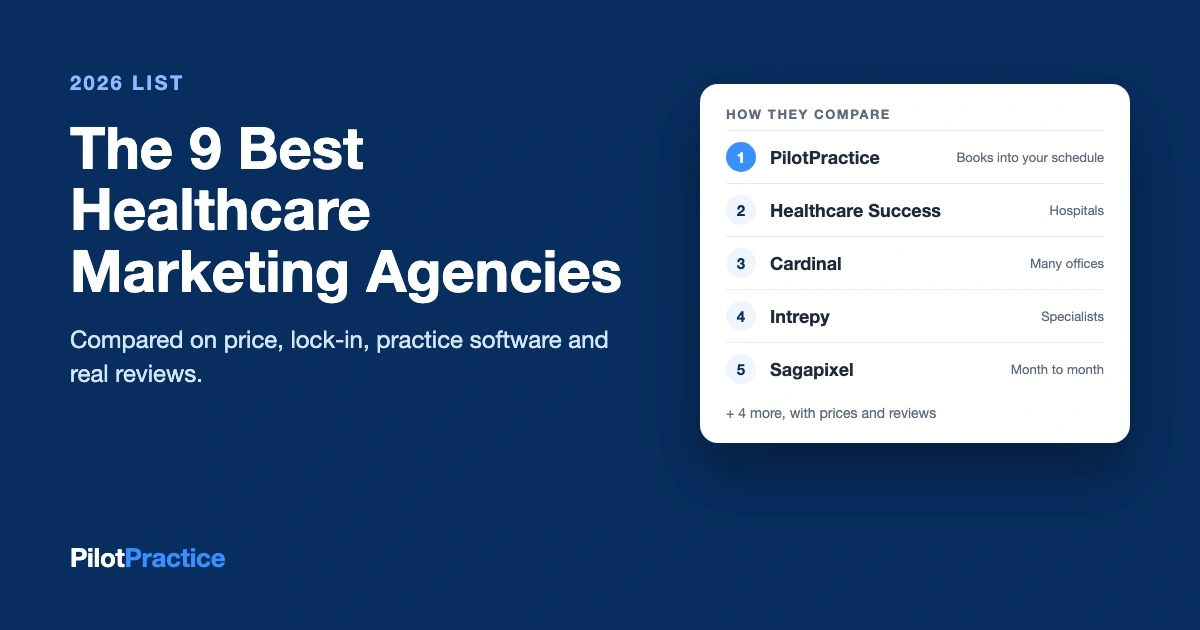
Most “best agency” lists are written by an agency that ranks itself first. We did that too, and we are telling you up front. But we checked every agency the same way: price, lock-in, booking and reviews. Then we put it all side by side, so you can choose.
One honest note: the order is our opinion. The facts in the table are not. Want a team that only does mental health? Then Beacon Media + Marketing or Rise4 may be your best pick.
TL;DR
- Our pick: PilotPractice, if you run a psychiatry, TMS, Spravato or group therapy practice and want ads judged by booked visits, with patients booking straight into SimplePractice, TherapyNotes, IntakeQ or athenahealth.
- Best mental-health-only pick: Beacon Media + Marketing (Google 4.8, 41 reviews). Best public price list: Lead to Recovery (from $750 a month, 90-day minimum). Cheapest website: Brighter Vision ($79–$319 a month).
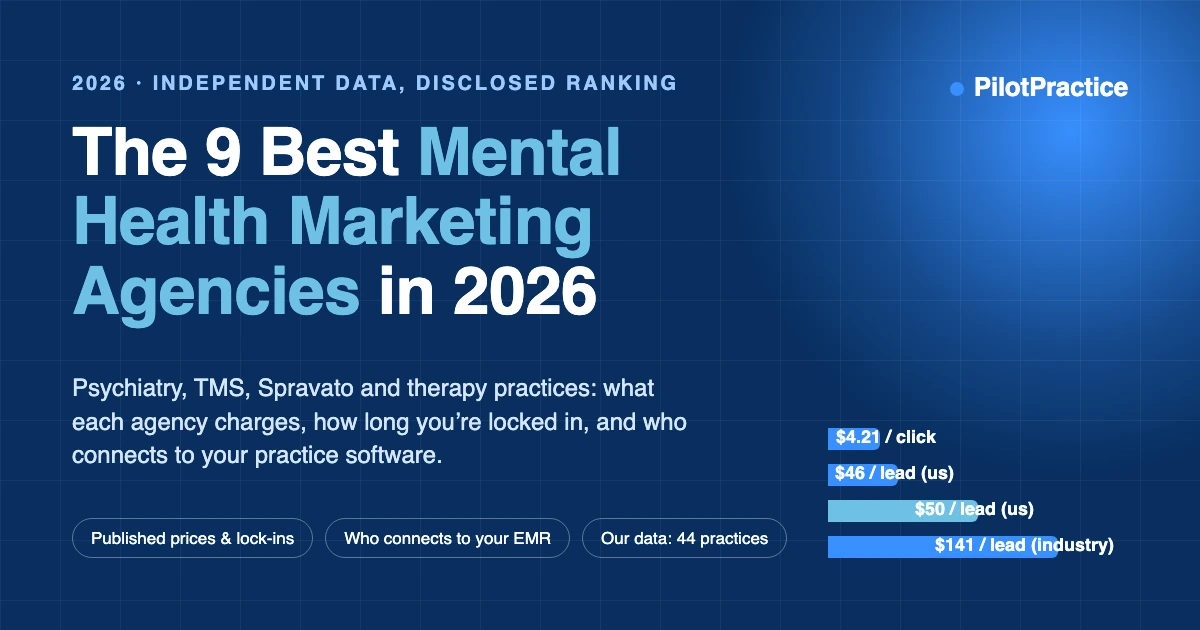
- What it costs: on average a practice pays about $140 for each new patient call or booking. Our therapy clients paid under $50. Agency fees come on top of what you pay Google or Facebook.
- Before you sign: ask how long the contract is, who keeps your website and ad accounts, and which scheduling software they connect to. And nobody can show your ads again to past visitors; Google does not allow it for mental health.
The 9 best mental health marketing agencies in 2026
1. PilotPractice (performance marketing judged by booked visits)
Best for: Psychiatry, TMS and therapy groups that want ads judged by booked visits, not clicks.
Full disclosure: this is our article, and we put ourselves first. We do not work only with mental health practices. If that matters most, Beacon Media + Marketing and Rise4 beat us there.
What we do differently. We are a performance marketing agency. We judge every ad by one thing: how many visits it booked, not how many clicks it got. Most agencies stop at the click or the call. We follow each one all the way to the booked visit. A person who calls at night and gets voicemail often never calls back. Our tools connect to SimplePractice, TherapyNotes, IntakeQ, AdvancedMD, athenahealth, drchrono, Valant and Tebra.
Pros
- Patients book themselves. They pick a real open time on your website. It goes straight into your own scheduling software. No “request an appointment” form.
- An AI phone helper answers after hours. It answers questions, checks insurance and books the visit into your schedule.
- Missed calls get a text back within seconds. That way the patient does not call someone else.
Cons
- We are not mental-health-only. We also work with dentists, skin doctors and med spas.
- We do not post a price list.
- We do not market live-in addiction programs; Webserv and Lead to Recovery do.
- Want blogs written by a therapist? Try Mental Health Marketing or Place Digital.


Price. We give you a quote based on your practice. Online booking, texting, insurance checks and the AI phone helper are included.
Proof. Read about our mental health clients: Revival Psychiatry, Wiser Counseling, Mindset TMS, Archway Psychotherapy, Astra Psychiatry, Sunshine Psychiatry, Insight Wellness and Mindful Paths. Revival Psychiatry got nearly 80% more Spravato patients.

2. Beacon Media + Marketing (mental-health-only, for therapy and counseling groups)
Best for: Therapy and counseling groups that want a mental-health-only team.
Beacon works only with mental and behavioral health practices. Its success stories name real clients.
What they do: ads, websites and showing up on Google. What it costs: not published. Its smallest job is $1,000, says Clutch. Lock-in: not published.
Pros
- Google gives them 4.8 stars (41 reviews).
Cons
- No prices up front, and no help with missed calls or booking.
3. Cardinal Digital Marketing (behavioral-health groups with 10+ locations)
Best for: Behavioral health groups with 10+ locations.
Cardinal works with big groups that have many offices.
What it costs: not published. Its smallest job is $5,000, says Clutch. Lock-in: not published.
Pros
- Its own staff rate it well, so the team tends to stay.
Cons
- A single practice would be its smallest client.
4. Rise4 (TMS, Spravato and ketamine clinics)
Best for: TMS and ketamine clinics.
Rise4 was started by people who ran TMS clinics. Its own team can answer your new patient calls.
What they do: ads and websites. Their staff also schedule patients and check insurance. What it costs: not published. Lock-in: not published.
Pros
- They know TMS well, from the inside.
Cons
- No public reviews.
- Patient info stays with their team, not in your software.
5. Lead to Recovery (a public price list)
Best for: Practices that want to see prices first.
Lead to Recovery posts its prices for everyone to see.
What they do: showing up on Google, Google ads and websites. What it costs: from $750 a month. Running your Google ads starts at $1,000 a month. Lock-in: 90 days. After that, you are free to leave.
Pros
- Posts its prices for everyone to see.
- Only a 90-day lock-in. After that, you are free to leave.
Cons
- No public reviews, and no phone or booking tools.
6. Mental Health Marketing (a project, not a contract)
Best for: Solo and small-group therapists who want a project, not a contract.
This small studio is open and honest about money.
What they do: websites, ads and showing up on Google. What it costs: from a $400 talk up to $8,000+ for a custom website. Lock-in: none. You pay month to month and can stop anytime.
Pros
- It does not promise results it can’t control. It has one Google review (5.0).
Cons
- No booking or phone tools.
- Not built for big groups.
7. Brighter Vision (a cheap therapist website, fine print read)
Best for: Therapists who need a website this month for under $100.
Brighter Vision sells ready-made websites for therapists.
What it costs: $79 to $319 a month. Ads help is $125 a month, plus a share of your ad budget. Email that keeps patient information private costs a little more. Lock-in: monthly or yearly. Yearly plans have a $100 cancel fee.
Pros
- Cheap and quick.
Cons
- Refunds are hard once work starts.
- Your site lives on their system, so ask what you keep if you leave.
8. Healthcare Success (hospital-affiliated and large systems)
Best for: Hospitals and large behavioral health systems.
Healthcare Success is an older agency that works with big health systems.
What they do: a full marketing team for brand, ads, Google and reviews. What it costs: not published. Its smallest job is $25,000, the highest on this list. Lock-in: not published.
Pros
- An older agency that works with big health systems.
- Google gives them 5.0 stars (8 reviews).
Cons
- Only 8 Google reviews.
- Not a fit for private practices.
9. Webserv (residential and outpatient treatment facilities)
Best for: Live-in and outpatient treatment centers.
Webserv works only with treatment centers. It also ranks itself first on its own list.
What they do: ads and showing up on Google. What it costs: not published. Its smallest job is $5,000, says Clutch. Lock-in: not published.
Pros
- A 5.0 rating on Clutch. It also works inside your admissions software.
Cons
- Some staff reviews mention burnout.
- Not a fit for therapy practices.
Quick comparison: the 9 agencies side by side
| # | Agency | What they charge | How long you’re locked in | Connects to your scheduling software? | Reviews | Best for |
|---|---|---|---|---|---|---|
| 1 | PilotPractice (that’s us)Performance marketing, healthcare only | Quote based on your practice | Terms shared with your quote | Yes — SimplePractice, TherapyNotes, IntakeQ, athenahealth and others. Patients book right into your schedule. An AI phone helper books after hours. | Google 5.0 (31) | Psychiatry, TMS and therapy groups that want ads judged by booked visits, not clicks |
| 2 | Beacon Media + MarketingMental health only | Not published (smallest job $1,000 on Clutch) | Not published | No | Google 4.8 (41) | Therapy and counseling groups that want a mental-health-only team |
| 3 | Cardinal Digital MarketingBig healthcare groups | Not published (smallest job $5,000 on Clutch) | Not published | No | Google 4.6 (74) | Behavioral health groups with 10+ locations |
| 4 | Rise4TMS, Spravato, ketamine | Not published | Not published | No (their own staff take your calls) | No public reviews found | TMS and ketamine clinics |
| 5 | Lead to RecoveryBehavioral health + addiction | $750–$7,500/mo, Google Ads from $1,000/mo | 90-day minimum | No | Clutch 0 reviews | Practices that want to see prices first |
| 6 | Mental Health MarketingTherapists and small practices | $400 consult to $8,000+ websites | Month to month | No | Google 5.0 (1) | Solo and small-group therapists who want a project, not a contract |
| 7 | Brighter VisionTherapist websites | $79–$319/mo; ads $125/mo + 10% of budget | Monthly, or yearly with $100 setup and $100 cancel fee | No | Mixed on software review sites | Therapists who need a website this month for under $100 |
| 8 | Healthcare SuccessAll of healthcare | Not published (smallest job $25,000 on Clutch) | Not published | No | Google 5.0 (8) | Hospitals and large behavioral health systems |
| 9 | WebservAddiction + mental health centers | Not published (smallest job $5,000 on Clutch) | Not published | Works inside your admissions software | Google 4.2 (5) | Live-in and outpatient treatment centers |
Swipe sideways to see every column →
Ratings checked October 2026. “Not published” means the agency does not show it on its website.
Our pick for each kind of practice
Solo therapist on a small budget
Brighter Vision or Mental Health Marketing.
Group therapy practice
PilotPractice for booking and after-hours calls. Beacon for mental-health-only. Lead to Recovery for public prices.
Psychiatry or Spravato
PilotPractice. Online booking and the after-hours phone helper help most here.
TMS or ketamine clinic
Rise4 to hand off your calls. PilotPractice to keep booking in your own software.
10 or more locations
Cardinal, Healthcare Success, or PilotPractice.
Addiction treatment center
Webserv or Lead to Recovery. Get LegitScript approval first.
What mental health marketing actually costs in 2026
On average, a mental health practice pays about $140 for each new patient call or booking. Our therapy clients paid under $50.
Three easy takeaways.
- Clicks cost about the same for everyone. No agency gets a secret discount from Google.
- What happens after the click matters most. Patients should be able to book right on the page. That is what makes each new patient cost less.
- Ads cost extra. Agency fees come on top of what you pay Google or Facebook.
A rule just for mental health. Google will not let your ads follow people who visited your site. Anyone who promises this has not run mental health ads before.
Numbers to hold any mental health agency to
| What to check | Good | Time to worry |
|---|---|---|
| Cost of each new patient call or booking | Under $60 for therapy, $70 for psychiatry | Over $150 |
| Calls that turn into booked visits | More than half | Less than a third. Fix the phones before buying more ads. |
| Cost of each booked new therapy patient | Under $100 | Over $300 |
| What the monthly report shows | Booked visits, and which ad brought each one | Only how many people saw your ads |
How to choose a mental health marketing agency
Three things decide most of it: the fine print on “guarantees,” the connection to your scheduling software, and the contract.
The “guarantees,” in plain English
| Agency | What they promise | What it really means |
|---|---|---|
| Lead to Recovery | A few new patients a month, after 90 days | A guess, not a promise. |
| Rise4 | Big returns, based on one clinic’s story | One good story, not a promise. |
| Beyond Marketing, Mental Health Marketing | No promise, and they say so | Honest. If it doesn’t work, you can leave. |
| Brighter Vision | Refund on yearly plans | Only before the first design is made. |
| PilotPractice | No promise | Ask every agency, us too, to put its terms on paper. |
Who actually connects to your practice software
“We connect to your systems” can mean three very different things:
- Real connection: patients can book right into your schedule.
- Reports only: they can see your numbers, but can’t book anything.
- Spreadsheet: you email them a file each month.
| Agency | IntakeQ | AdvancedMD | athenahealth | drchrono | SimplePractice / TherapyNotes | What it does | Patients can book into your schedule? |
|---|---|---|---|---|---|---|---|
| PilotPractice | ✓ | ✓ | ✓ | ✓ | ✓ | Real connection | Yes — on your website and through the AI phone helper |
| MHIS | — | — | — | — | Claimed | Reports only (site down, not checked) | Not stated |
| Webserv | Works inside your admissions software; names not shared | Reports only | No | ||||
| Rise4 | No connection — their staff book for you | People on their team | Through their staff, not your site | ||||
| Beyond Marketing, Therapy Flow | Their own patient tool, separate from your records | A second system to keep up | Into their tool, not your schedule | ||||
| Beacon, Cardinal, Healthcare Success, Lead to Recovery, Mental Health Marketing, Practis | No connection | Counts calls only | No | ||||
| Brighter Vision | No connection (website only) | Contact form | No | ||||
Swipe sideways to see every column →
From what each agency posts. “—” means not listed. Ask any agency to show you the connection on a real client’s account.
Six questions to ask before you sign anything
Ask this
- How long is the contract, and how do I cancel?
- If I leave, who keeps my website and my ad accounts?
- Which scheduling software do you connect to? Can you show me on a real client’s account?
- Have you run mental health ads before? What does Google not let you do?
- Who answers my phones at night and on weekends? Many patients reach out then.
- Which clients left you last year, and why?
Skip an agency that
- Won’t show you the contract before you sign.
- Keeps your website or ad accounts when you leave.
- Promises to show your ads again to people who visited your site. Google does not allow it for most mental health care.
- Can’t name the scheduling software it connects to, or show it on a real client’s account.
How we ranked these agencies
How we made this list. We read each agency’s website, prices and rules. We checked their reviews on Google, Clutch, Glassdoor and the BBB. If an agency hides a price, we say Not published. We never guess.
What we checked that other lists don’t
- The contract. How long are you stuck? Few agencies say.
- The software. Can patients book straight into your schedule?
- Different kinds of care. Therapy, psychiatry and TMS are not the same business.
- Reviews from many sites. We read the bad ones too.
- Simple goals. We show what “good” looks like.
Seen on every other list — and the catch with each
You will see these names on other lists too. Here is the catch with the biggest ones.
- MHIS (Mental Health IS) — makes big claims and ranks itself first. Its website would not load when we checked.
- Therapy Flow — its main web address now shows a “domain for sale” page. Make sure it is still open before you pay.
- Stethon and Focus Digital — top some “best of” lists. Those lists are press releases on unknown sites. Treat them like ads.
Frequently asked questions
How much should a mental health practice spend on marketing in 2026?
Most therapists spend under $100 a month. Growing practices spend more. One new weekly therapy client can be worth about $7,000 a year. So good marketing can pay for itself.
What does a mental health marketing agency cost per month?
A simple Brighter Vision website starts at $79 a month. Lead to Recovery starts at $750 a month. Ads on Google or Facebook cost extra.
What should a new patient cost from Google Ads?
On average, practices pay about $140 for each new patient call or booking. Our therapy and psychiatry clients paid about $50. Their patients could book right on the page.
Should I hire a mental-health-only agency or a healthcare agency?
Need more people to reach out? A mental-health-only agency is a safe pick. Losing people to voicemail? Pick a team, like us, that also handles booking and phones.
Can an agency show my ads again to people who visited my site?
Not for most mental health care. Google treats depression, anxiety and addiction care as a sensitive topic. So ads can’t follow past visitors. Facebook has similar limits.
How long until I see results?
Google ads can bring calls in the first week. Showing up higher on Google Maps takes a few months. Don’t count on directory sites; they send fewer referrals each year.
Why is PilotPractice #1 on its own list?
Because we wrote it, and we say so. We also show where we fall short and who to pick instead. Use the table, not the order.
See your own numbers before you pick anyone
We’ll show you what practices near you pay for each new patient. We’ll also check how easy it is to book on your website. It’s free.
Sources: each agency’s own website, plus reviews on Google, Clutch, Glassdoor and the BBB. Industry averages come from LocaliQ/WordStream. Our numbers come from our clients’ Google Ads accounts, added together. Found a mistake? Email [email protected] and we’ll fix it.