Updated October 2026 · 9-minute read
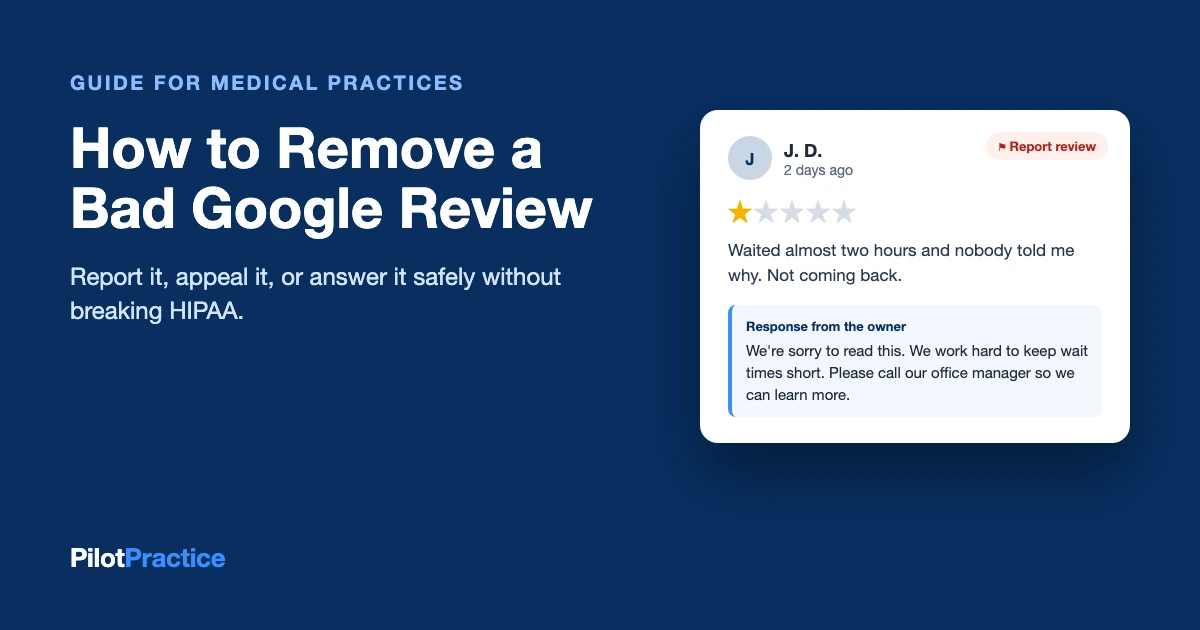
A one-star review on your Google listing can feel like a punch. Your first thought is to make it disappear. But you usually can’t delete a bad Google review yourself. Only Google can, and only when the review breaks Google’s rules.
So you have three moves. Report the reviews that break the rules. Answer the rest in a calm way that doesn’t break HIPAA. Then get more good reviews, so one bad one stops mattering. This guide walks through each step, with reply templates your front desk can copy.
TL;DR
The short answer: report a review only if it breaks a Google rule. Reply to every bad review, safely. The best long-term fix is a steady flow of new, honest reviews.
- Google removes fake, spam, off-topic, hateful or threatening reviews. It doesn’t remove honest complaints.
- You get one appeal per review if Google says no at first.
- Never confirm the person is your patient in a reply. Practices have paid $10,000 and $23,000 HIPAA fines for this.
Can you remove a bad Google review?
Not by yourself. A practice can’t delete reviews from its own Google listing. Only Google can take one down, and only if it breaks Google’s content rules.
That leaves a simple choice for each bad review. If it breaks a rule, report it. If it’s an honest complaint, reply to it. Many reviews get both: you report a fake one, and you still post a polite reply, because future patients will read it.
Do this
Report reviews that are fake, off topic, hateful, threatening or share private details.
Skip this
Reporting honest one-star reviews. It won’t work, and it uses up your one appeal.
Our take: most bad reviews stay up. Plan to answer them well, not to make them vanish.
Which reviews will Google take down?
Google removes reviews that break its rules for content on Maps. Here’s what that covers.
| Type of review | What it looks like | Reason to pick |
|---|---|---|
| Fake or spam | The person was never there, one person posts many reviews, or a review was paid for. | Spam |
| Off topic | It’s about politics, the news or a different business. | Off topic |
| Conflict of interest | A competitor, an angry ex-employee, or someone pushing their own business. | Conflict of interest |
| Rude language | Swearing used to insult your team. | Profanity |
| Threats or bullying | Threats against a staff member, or attacks on one person. | Bullying or harassment |
| Hate speech | Attacks on a group because of race, religion, gender and so on. | Discrimination or hate speech |
| Private details | A staff member’s home address or personal phone number. | Personal information |
Source: Google’s prohibited and restricted content policy for Maps.
Which reviews will Google leave up?
Most bad reviews land here. Google leaves them up, even when they sting.
- A real patient who had a bad visit and says so.
- A review you think is unfair or one-sided.
- Complaints about wait times, bills, parking or staff manners.
- A one-star rating with no words at all.
Our take: for these, skip reporting and go straight to a safe reply.
How do you report a bad Google review?
You need to be an owner or manager of your Google Business Profile. Then use one of these two ways.
From your Business Profile:
- Search your practice name on Google while signed in.
- Click Read reviews, then the report icon next to the review.
- Pick the rule it breaks, such as Spam, and click Send report.
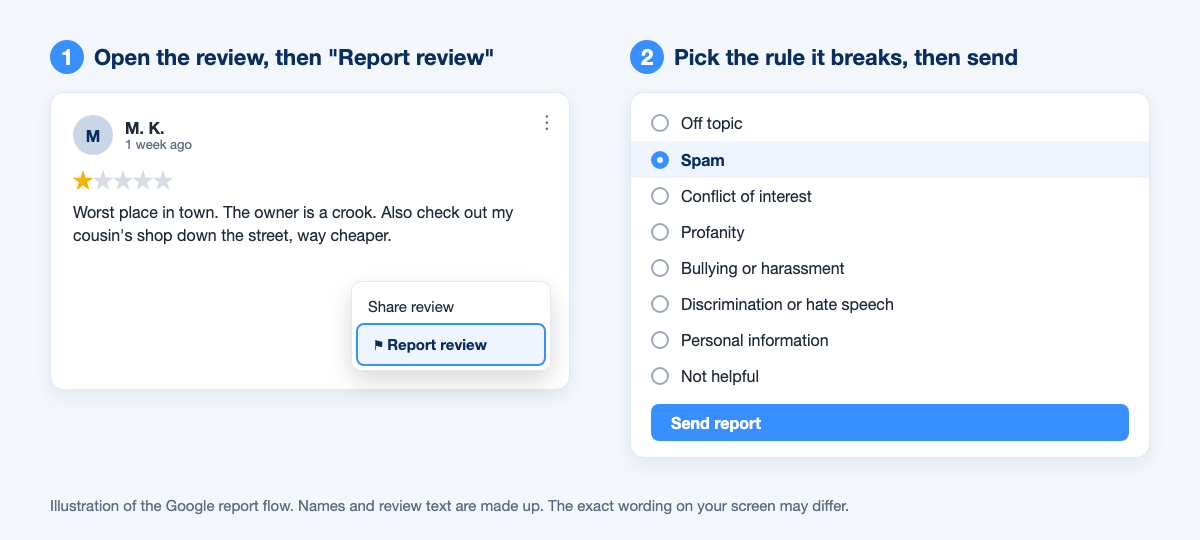
From the Reviews Management Tool: pick your practice, choose Report a new review for removal, click Report next to the review, pick the reason and submit. This tool is also where you track every report.
Google says a check usually takes several days. Report each review once. Asking staff to flag it again and again doesn’t help.
How do you appeal if Google says no?
Open the Reviews Management Tool to see where each report stands. You’ll see one of three notes.
- Decision pending: Google hasn’t looked yet.
- Report reviewed, no policy violation: Google said no. You can appeal one time.
- Escalated: a person at Google is checking your appeal. Watch your email.
To appeal, choose Check the status of a review I reported previously and appeal options. Click Appeal eligible reviews, pick the review and fill in the short form. You can send up to 10 at once.
Our take: you only get one appeal per review. Name the exact rule it breaks and say why in one or two plain sentences.
Source: Google’s help page, Report inappropriate reviews on your Business Profile.
What if a Google review is false and harmful?
Some reviews tell outright lies, like saying a doctor did something illegal. Google has a separate legal removal request for these.
Do this
Use the legal form for a clear false statement of fact. Talk to a lawyer first, since each state’s rules differ.
Skip this
Suing over an honest bad experience. It draws more eyes to the review, and court papers can bring HIPAA trouble of their own.
How do you reply to a bad Google review without breaking HIPAA?
A calm reply shows future patients you care. A careless reply can cost real money. The federal health privacy office has fined practices for it.
The American Medical Association puts it plainly: “Don’t even acknowledge the person is a patient in your office.” A patient posting about their own visit doesn’t give you permission to talk about it.
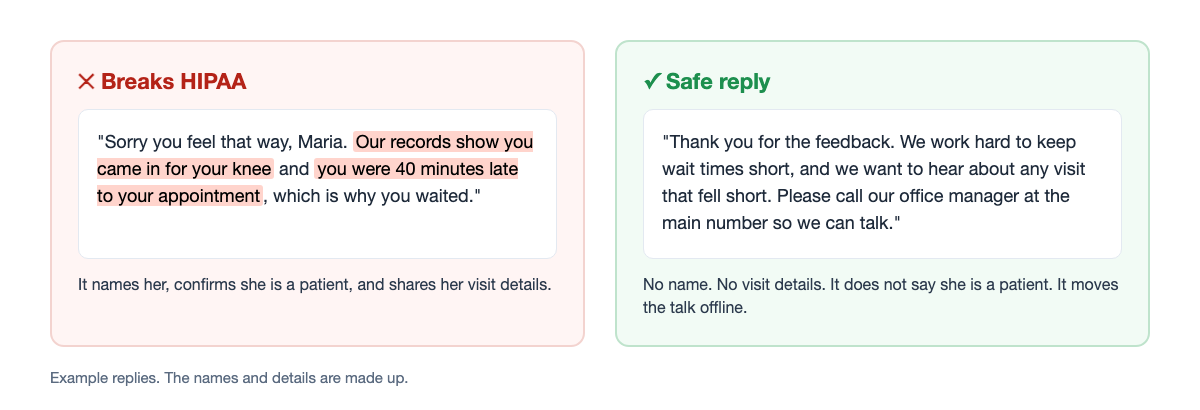
What are the rules for every reply?
- No names. Not even the name shown on the review.
- No visit details. No dates, treatments, results, bills or insurance.
- Don’t confirm or deny. Don’t write “you were never our patient” either. Stay neutral.
- Talk about your policies, not the person. “We aim to see every patient on time” is fine.
- Move it offline. Ask them to call the office manager at your main number, never a personal one.
- Wait an hour. Never reply while upset. Have a second person read it first.
- Keep it short. Two to four sentences is plenty.
Our take: if a reply would make sense under any review, it’s probably safe. If it only makes sense for this one person, rewrite it.
What can you write back to a bad review?
Change a few words so each reply sounds like you. Pasting the exact same text everywhere looks fake.
General complaint:
“Thank you for sharing this. We want every visit to feel good, and we take feedback like this seriously. Please call our office manager at our main number so we can talk it through.”
Long wait:
“We’re sorry to hear about a long wait. Our goal is to keep every visit on time. Please call our office manager so we can learn more and do better.”
Billing:
“Bills should never be confusing. We’re happy to walk anyone through charges and insurance. Please call our billing team at our main number.”
Rude staff:
“Kindness matters to us, and this isn’t the experience we want anyone to have. Please call our office manager so we can look into it.”
A review you think is fake:
“We take all feedback seriously, but we can’t look into this from the review alone. If you’d like to talk, please call our office manager at our main number.”
A complaint about care:
“Every care plan is built around each patient’s needs, and we never discuss anyone’s care in public. We’d welcome a call to our practice manager about any concern.”
What should you never write?
| Don’t write | Why it’s a problem |
|---|---|
| “Hi Sarah, sorry about your visit.” | Using her name confirms she’s a patient. |
| “Our records show you missed two appointments.” | That’s private health information. |
| “You were never a patient here.” | It’s still a statement about who is or isn’t a patient. |
| “Your results were normal for that procedure.” | It shares their treatment and outcome. |
| “Take this down or we’ll call our lawyer.” | It looks bad to every reader and can count as review pressure. |
| “We’ll give you a free visit if you change your review.” | Rewards for review changes break Google’s rules and federal rules. |
Should you pay a company to remove bad reviews?
Some companies promise to “remove any review.” Be very careful.
- Some file fake legal or copyright claims. When Google catches on, the review often comes back, and the story gets bigger.
- The FTC’s 2024 rule on reviews bans fake reviews. It also bans using threats or false claims to get honest reviews taken down. Fines are counted per review.
- Google can put a warning on your listing when it spots fake or bought reviews.
Do this
Hire help that reports real rule breaks, writes safe replies and grows your new reviews.
Skip this
Anyone who guarantees removal of honest reviews, or offers to post reviews for you.
What is the real fix for bad Google reviews?
A practice with 200 reviews barely notices one bad one. A practice with 12 feels every one. The best defense is a steady flow of new, honest reviews.
- Ask every patient. Google bans asking only the ones you expect to be kind. That’s called review gating.
- Ask soon. A text a few hours after the visit beats an email a week later.
- Make it one tap. Send a direct link to your Google review box.
- Never pay or reward. No discounts, gift cards or drawings.
At PilotPractice, we connect to your practice software and text a review request after each finished visit. You choose which visits get one, such as only surgery patients. See how our reputation management works, or read our guide to HIPAA-safe patient review requests.
What should you do when a bad review lands?
- Breathe. Don’t reply right away.
- Check the rules. Fake, off topic, hateful or sharing private details? Report it.
- Look inside your office, quietly. If it may be a real patient, have the manager look into it in private.
- Pick a template and make it your own. No names, no visit details.
- Get a second read, then post it.
- Fix the cause. If three reviews mention wait times, the wait is the real problem.
- Keep asking for reviews. Fresh good ones push the bad one down.
Reviews also help you show up on Google Maps. To see how reviews, your listing and your website work together, see how we help practices show up on Google.
Frequently asked questions
Can a practice delete a bad Google review?
No. Only Google can remove a review, and only when it breaks Google’s rules. You can report it, and you can appeal once if Google says no.
How long does Google take to remove a reported review?
Google says a check usually takes several days. Appeals can take longer. You’ll get an email with the final answer.
Is it a HIPAA violation to reply to a Google review?
Replying is fine. Sharing anything about the person’s care is not. Even saying they are your patient can count. Talk about your policies and ask them to call the office.
Can I find out who wrote an anonymous review?
Usually not. Google won’t say who wrote it unless a court orders it. Don’t guess in your reply, even if you think you know.
Can I offer a discount if a patient changes their review?
No. Rewards for changing or removing a review break Google’s rules and the FTC’s review rule. Fix the problem first. The patient may update the review on their own.
Should I reply to every review?
Reply to every bad review and as many good ones as you can. Keep each reply short and different. Never use names or visit details.
Will a bad review hurt my Google ranking?
One bad review won’t sink you. Google looks at how many reviews you have, how recent they are and your overall rating. A steady flow of new reviews matters more than any single one.
Get more good reviews, without the front desk chasing them
We’ll check your Google listing and reviews, and show you how many review requests your visits could send each month. It’s free.
Sources. Google Business Profile Help, Google Maps content policy, Google legal removal requests, HHS Office for Civil Rights settlement notices (2019 and 2022), American Medical Association practice management guidance, and the FTC’s 2024 rule on consumer reviews. This guide is not legal advice. See a mistake? Email [email protected] and we’ll fix it.