If you look at standard healthcare marketing advice, generalist agencies will often tell you to split your talk therapy budget evenly between Google and social media. They’ll build a campaign to show cold ads on Instagram and Facebook to people scrolling through their feeds, hoping to convince them to book an initial counseling intake.
At PilotPractice, we’ve audited and managed campaigns for dozens of traditional therapy practices, and we can tell you with absolute certainty: Running cold ads to find new patients on Facebook and Instagram is an inefficient use of your marketing budget.

In our core guide, The Ultimate Blueprint for Therapist Marketing: How to Stop Wasting Your Practice Budget on the Wrong Digital Ads, we explained the psychological reality of counseling search intent. Talk therapy is a high-intent, transactional service. Someone either realizes they need a therapist right now and actively searches for one, or they don’t. Seeing a generic graphic or video about mental health while scrolling through social media in bed at night isn’t going to suddenly trigger a stranger to book a session.
Does that mean you should turn off Facebook and Instagram entirely? Absolutely not. The secret is using therapy meta ads strictly for retargeting. Instead of trying to find new patients from scratch, you use these platforms to get back in front of the high-intent people who already clicked your search ads, visited your website, and walked away without booking. Here is our operational framework for using social media retargeting to close the loop on your search traffic.

The primary reason we love setting up therapy meta ads strictly for retargeting traditional counseling leads is the unmatched efficiency of the ad spend.
- The Cold Audience Problem: To show an ad to every adult within a 10-mile radius of your clinic on Facebook, you have to buy hundreds of thousands of impressions, most of which go to people who do not need therapy right now.
- The Retargeting Solution: A retargeting audience is tiny. It only includes the specific few hundred people who actually visited your website over the last 14 to 30 days.

Because you are bidding on such a small, hyper-focused pool of people, the daily cost to run these campaigns is remarkably low. For just a few dollars a day, you can completely saturate your custom audience, staying top-of-mind without expanding your client acquisition cost. It acts as an incredibly cheap insurance policy for your primary search ad budget.
The creative strategy for a retargeting-focused therapy meta ads campaign is completely different from a cold advertisement. You do not need to introduce who you are from scratch or explain what services you offer; the user already knows. Your ad copy and imagery should be designed entirely to lower the remaining barriers to entry.
We structure successful mental health retargeting ads around three primary pillars:
Pillar A: Simple, Reassuring Hand-Holding Copy
The tone must be entirely supportive and pressure-free. Use clean, soft visuals paired with comforting headlines like, “Taking the first step is the hardest part. We’re ready when you are.” Acknowledge that life gets busy, and invite them back to finish what they started.
Pillar B: Direct Insurance and Booking Validation
Financial uncertainty or a confusing booking process are the two biggest reasons people abandon a therapy site. Use your retargeting creative to feature a brief video or graphic that explicitly states: “We accept [Major Insurance Networks]. Verification takes less than 60 seconds.”
Pillar C: Frictionless Links to the Intake Screener
Never retarget someone on social media and send them back to your general website homepage. The ad call-to-action should link them directly back to your streamlined, interactive digital intake form or screening tool. This allows them to instantly pick up right where they left off, complete their inquiry, and route their data straight into your practice workflows.

We don’t just build marketing frameworks based on guesswork. We engineer end-to-end local patient pipelines that structurally reduce lead costs, protect your profit margins, and keep your therapists’ calendars consistently full.
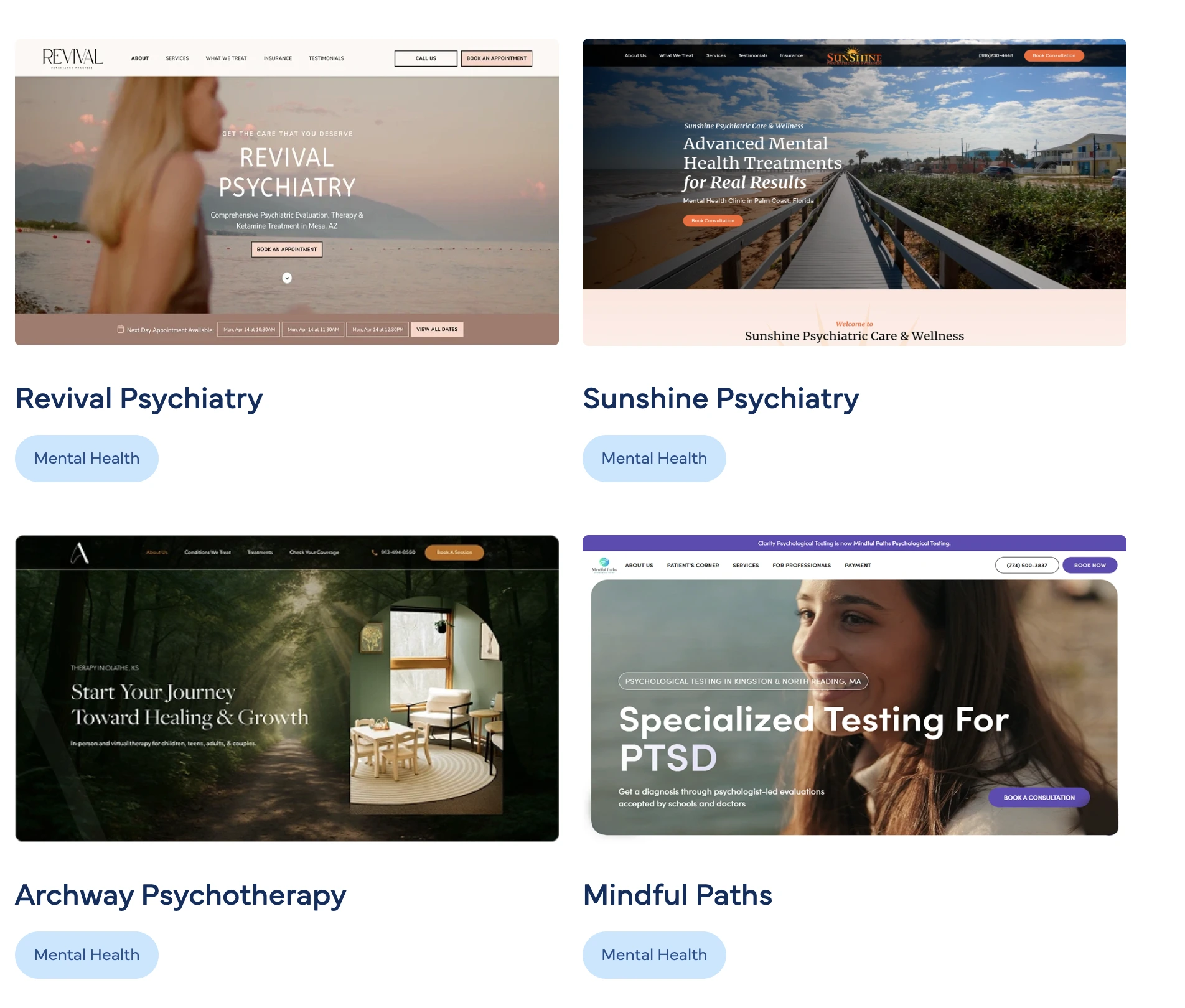
If you want to view the real operational data, campaign breakdowns, and growth milestones we have generated for counseling and psychiatric clinics nationwide using synchronized search and social campaigns, explore our comprehensive project history:
 Explore Our Mental Health Marketing Case Studies Portfolio
Stop letting high-intent traffic slip through the cracks of your digital funnel. If you aren’t running a synchronized cross-channel strategy that pairs the raw search intent of Google with the hyper-focused retargeting power of Facebook and Instagram, you are leaving your easiest patient bookings on the table.
At PilotPractice, we focus on operational math and patient behavior. We build hyper-targeted search pipelines to capture local demand, and wrap them in tight, cost-effective therapy meta ads loops to make sure every single dollar of your marketing budget takes your clinic further.
[Schedule a Free, Cross-Channel Campaign Audit with Our Team Today]